The Jurassic Period
Bedrock of Jurassic age is not found at the surface in north Norfolk - the closest is in the Fens near King's Lynn. The Jurassic lasted from 200 to 145 million years ago, and – as you may know - it was in the time of the dinosaurs. Thanks to the Pleistocene ice sheets Jurassic rocks and fossils have been transported to north Norfolk as part of their bed-load and melt water cargo. These transported rocks are known as erratics. (For more information about the timing and dynamics of these events see the Pleistocene section).
Introducing Jurassic rocks and fossils
There are two common types of Jurassic erratics found on the north Norfolk coast, both formed on the ancient seabed:
- Sandy-coloured limestone, often containing tiny, rounded balls known as oolites and also fossils.
- Grey mudstone, often with calcite crystals and fossils. There are also septarian nodules with distinctive cracks filled with calcite crystals.
Sandy-coloured Limestone
Sandy-coloured limestone specimens often contains fossil and rounded balls known as oolites
This limestone was commonly used in the Middle Ages to frame corners and flint panels in church walls in north-east Norfolk. It was imported from the Stamford area of Lincolnshire, for example the quarries at Barnack.
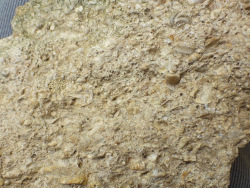 Middle Jurassic limestone containing oolite balls. Fossil fragments of snails (gastropods) and bivalve are visible.
 Close-up of oolitic limestone showing that the oolites are tiny mud concretions with concentric layers set in grey, crystalline calcite cement.
Grey Mudstone
Grey mudstone specimens often contain calcite crystals and fossils.
Upper Jurassic bedrock was deposited in deep-sea conditions with very little light, and the sediment which settled onto the sea bed was fine-grained and grey. It was cemented with lime which has sometimes turned into fine calcite crystals. Examples of strata include the Oxford Clay and Kimmeridge Clay. Fossils include sea-bed animals such as bivalves and free-swimming (pelagic) ones such as ammonites and belemnites and of course plankton whose remains are now invisible to the naked eye.
 A fossil-rich chunk of Upper Jurassic seabed – ammonites and curved bivalve shells are visible, set in a grey mudstone matrix.
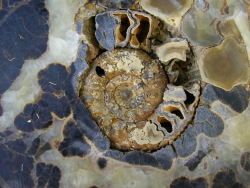 Part of an Upper Jurassic mudstone nodule known as a septaria. It has been cut and polished to reveal pale calcite crystals and a beautiful ammonite. Image courtesy Mike Hurn
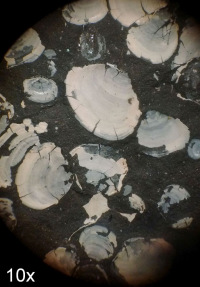 A close-up view of Upper Jurassic bivalve shells (a species of Isocyprina) set in a dark grey mudstone matrix. The rock was formed at the bottom of a deep sea in oxygen-poor conditions - it often has a tarry, hydrocarbon smell when struck.
 Two large Upper Jurassic bivalve shells of the species Gryphaea, otherwise known as Devil's Toenail. The shells of this species were wide to help support them on the soft seabed.