The Cretaceous period
Bedrock of Cretaceous age is exposed at the surface in the north Norfolk area – it is called the Chalk.
The Cretaceous lasted from 145 to 65 million years ago, and – as you possibly know – it ended with the huge meteorite impact which finished off the dinosaurs. The situation of Norfolk was under a warm tropical sea at this time.
The sea was rich in life. Some organisms had calcareous (lime) skeletons while others had siliceous (silica) skeletons. They contributed to forming chalk and flint respectively.
Chalk is a kind of pure limestone and its lime content reacts to strong acid by fizzing. Flint does not react.
Flints are found everywhere in our area. Some are fresh, knobbly nodules while others have been rolled and battered in the sea; some are orange or yellow because they have been buried in iron-rich sediment at some time. Flint is by far the most abundant beach material.
Very occasionally prehistoric flint tools are found on beaches – they should always be recorded at the Museum. You may be surprised at what you have found!
The Chalk
Chalk bedrock exposed on beaches such as Overstrand. It is an interesting source of Cretaceous flints and fossils; you can also find them loose on the beach.
Our example is a belemnite; urchin (echinoid) fossils may be found embedded in the bedrock too, but they are usually too fragile to survive attempts at removal. However, if flint has infilled the body cavity they may survive well.
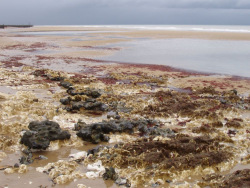 Exposed chalk at Overstrand.
 A species of belemnite Belemnitella embedded in chalk bedrock exposed in the wave-eroded shore platform at Runton.
 The looping pattern of a fossil sponge Plocoscyphia exposed in the foreshore at Runton.
Flint formed from microscopic fossil silica debris in the chalk. Raw flint is black or grey, but may later become iron-stained. Flint from Yorkshire and Lincolnshire, transported by water or ice action, tends to be pale grey in colour.
 Raw flint formed within the chalk in a variety of shapes, including sheets, and horns. It also formed inside fossil shells and animal burrows. This picture shows a burrow system, probably crustacean – the entrance must have been top left.
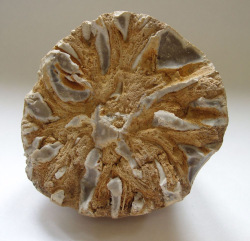 A flint cobble broken open to reveal a sponge fossil. These flint sponges are rarely well preserved, as the process of converting the fossil material from lime to silica has tended to destroy the organic detail.
 After a long time in the sea, flints become rounded and pitted with impact craters where pebbles have clacked against them. This effect is known as chatter-marking. Almost all flints on north-east Norfolk beaches are chatter-marked.
 Ring-shaped flint masses are one of the wonders of the Chalk exposed in the beach at West Runton. Their origin is disputed, but plausible explanations include chemical changes induced by the activity of worms or barrel sponges on the Cretaceous seabed. The popular name for them is paramoudra.
 Small flint rings known as potstones are also found on local beaches. They should never be removed from the beach. This one has its chalk core bored by Polydora worms.
 The flint cast of the inside of a Micraster urchin shell. These fossils are very collectable. The original calcareous matter of the shell dissolved to form a mould into which silica seeped in gel form before hardening into flint.
 The flint cast of the inside of an Echinocorys urchin shell. showing the plates composing the shell. Distorted specimens are often found, damaged by movements on the sea bed before the silica investment process had finished.
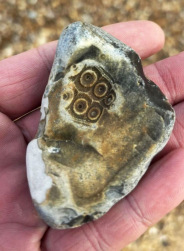 The flint cast of the inside of an urchin shell of the cidarid family. The circular shapes are bosses where large, club-shaped spines were attached to the surface of the shell. Image courtesy John Middleton.