The Pleistocene Warm Periods
There are rocks and fossils preserved from three warm periods in our area. The earliest is known as the Cromerian Complex and dates from between about 0.8 and 0.6 million years ago. The climate was variable but temperate.
The most distinctive deposit is the Cromer Forest-bed Formation (CFB). It was deposited on land while the Wroxham Crag was being deposited offshore.
The best place to see the CFB is at West Runton cliff. One horizon called the Freshwater Bed as a compacted layer of dark brown, organic-rich silt at the foot of the cliff. It was deposited on the floodplain of a river. It is overlain and underlain by layers of Wroxham Crag, so it represents an episode of lowered sea level when land conditions were temporarily present. Glacial deposits form the majority of the cliff.
 The Forest-bed at the foot of the cliffs at West Runton.
 River valley fossils are found in abundance in the Forest-bed Formation.
The West Runton Freshwater Bed is packed with fossil snail, bivalve, beetle and plant remains typical of a river valley. A wealth of mammal fossils from this bed including mole, vole, rhinoceros, lion and hyaena. The famous West Runton mammoth came from this deposit.
 A molar tooth of extinct Giant Beaver from the Cromer Forest-bed Formation.
 The pre-molar tooth of a wild boar from the Forest-bed.
 The tooth of a red deer found in the Forest-bed.
 There are more organic-rich CFB deposits at Beeston cliffs. They are slightly older than those at West Runton. They contain plant and animal fossils. Pollen of pine, birch and willow indicates cooler conditions at this time during the Cromerian Complex. The geologist Martin Warren is examining them.
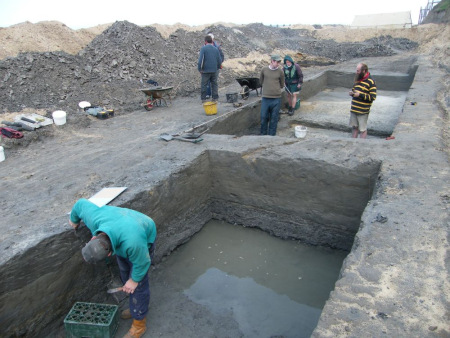 There are CFB deposits below beach level at Happisburgh. This is the famous site with evidence for the oldest human footprints in northern Europe, dated c.0.8 million years old. Excavations have revealed evidence of flint tools from this time. Image courtesy Martin Warren.
 A struck flint flake – precious evidence for early human activity. Image courtesy Martin Warren.
 Part of a Crag whale vertebra from Sidestrand. It is the transverse process from the side of a vertebral disc. It is heavily mineralised with iron oxides.
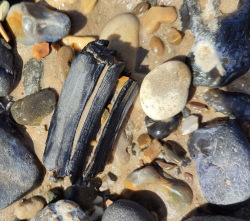 A molar tooth of the extinct horse Equus major from Sidestrand. Image courtesy Jonathan Gould
 The Deep History Coast panels along the north Norfolk coast explain the story of early humans in North-east Norfolk.
 A foot (lunar) bone of Hippopotamus from Sheringham beach. Interestingly, hippo has not been found in the West Runton Freshwater Bed though it is recorded from older CFB deposits. Image courtesy Jon Stewart
 A neck (cervical) vertebra of bison from Sheringham beach. It is incomplete but the surviving fragments have been assembled and carefully conserved. Image courtesy Jonathan Stewart.
We have evidence for other Pleistocene warm periods in north-east Norfolk:
- The Hoxnian interglacial (c.400.000 BP) at Trimingham.
- The Ipswichian interglacial (c.120,000 BP) at Mundesley.
 The Mundesley Freshwater Bed of Ipswichian age used to be visible at Mundesley in the 19th century, as recorded by geologist Clement Reid. Fossil finds included Straight-tusked Elephant and European Pond Turtle. The cliffs are now grassed over and protected from erosion by the sea, however Cromerian fossil finds can sometimes be found on the beach.
North-east Norfolk is one of the most important areas for Palaeolithic research in Europe. It is vital that any finds of flint tools (or even suspected ones) found on beaches are recorded by museum experts.