The Pleistocene Period - The Crag Sea
Commonly known as the Ice Age, the Pleistocene period lasted from 2.56 million to 10,000 years ago. This was the time of marked swings in the Earth's climate, resulting after 700,000 years ago in a series of very cold, glacial periods and intervening warmer or milder interglacial periods. Sea levels were higher in warmer periods and lower in colder periods. As an added complication, Norfolk been an uplifted by at least 50 metres over the past 2 million years – this is the result of changes in the Earth's crust.
 Adapted from the chart 'Five million years of Climate Change from Sediment Cores' by R.A.Rhohde, courtesy Wikipedia.
 Today the ice sheet is nearly 3,000 kilometres north of the Norfolk coast, on Svarlbard.
We have good geological and fossil evidence for this glacial/interglacial story in north-east Norfolk, although it is patchy in places (there are big stretches of time when the evidence was removed by ice sheets or the sea). Rocks and fossils originating from both land and sea have been preserved.
The Crag Sea
The earliest surviving Pleistocene rocks are known as the Crag. It formed offshore in the North Sea as yellow or brown sands, gravels and muds.
In north Norfolk we have the Wroxham Crag formation, resting on Chalk bedrock. It spans a time period from about 1.8 to 0.7 million years ago.
The Wroxham Crag contains marine fossils including shells, fish and whale bones; also fossils of land animals washed out to sea.
 Sidestrand beach covered with a iron-stained flint cobbles eroded from the Wroxham Crag. These Crag sediments are naturally cemented by iron oxides as well as lime (leached from shelly material).
Crag shells are usually fragile and so may be difficult to collect successfully. Beach fossils will need soaking in fresh water to remove salt.
 Crag at Sidestrand. Two chalk 'rafts' in the cliffs were shunted up into Wroxham Crag by glacial action.
 Crag sands and gravels can be found lying above and beneath the chalk rafts at Sidestrand.
At Weybourne cliff the Crag rests on the Chalk. As the North Sea advanced over the Chalk it rolled up flints into a Crag basement bed which contains shells, and sometimes animal bones and teeth.
 At Weybourne Hope, the Crag basement bed is exposed on top of an undulating yellow-stained surface of eroded chalk. (Brown glacial deposits make up the top two-thirds of the cliff.)
 Contortions in the sands and gravel of the cliffs at Weybourne, as they drop down to a lower level.
Specimens - the Crag Sea
 The base of a large antler from the Wroxham Crag from Cromer beach found by Martin Warren. It is probably from the giant elk species Cervalces latifrons. Note the yellow colouration typical of Crag mammal specimens.
 Layers of iron-rich mudstone are found in the Crag and may end up as crusts on the beach. The mineral cement is dark brown Goethite (iron oxide) which weathers to yellow Limonite (iron hydroxide).
 A water-worn flint nodule of grey flint showing iron-stained colouration.
 Part of a Crag whale vertebra from Sidestrand. It is the transverse process from the side of a vertebral disc. It is heavily mineralised with iron oxides.
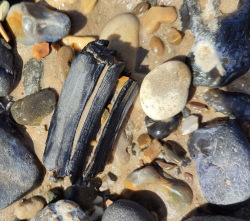 A molar tooth of the extinct horse Equus major from Sidestrand. Image courtesy Jonathan Gould
 The fossil imprint of a leaf – perhaps willow – in iron-cemented mudstone from Happisburgh beach
 Part of a Giant Deer vertebra found in the Wroxham Crag at West Runton beach, by palaeontologist John Clayden. NB it is embedded in an iron-cemented matrix of sand and gravel. Expert care will be needed to conserve it.
 A fragment of molar tooth from a Southern Mammoth from Happisburgh beach, probably eroded from early Pleistocene deposits offshore. Note the wide spacing of the tooth plates – this helps distinguish Southern from later Woolly Mammoth which has plates much closer together. Image courtesy Connor Holifield.
 Pieces of water-worn fossil bone are often found on the beaches of north-east Norfolk. Sometimes it is possible to identify them to body part and even to the animal they came from.
 Fossil bone.
 Fossil wood.
 Fossil wood typically shows annual growth rings in cross-section.
 Fossil bone typically has a honeycomb-like structure.
Mammal fossils from the beach needs careful conservation if they are not to fall apart when dry:
- soaking in several changes of fresh water over several months to help get salt out;
- use of a progressive drying technique;
- chemical consolidant such as Paraloid B-72 to stabilise the material.
Ask at Cromer Museum for an advice sheet.