The Pleistocene Cold Periods
We have evidence that at least two (perhaps three) ice sheets directly affected north-east Norfolk. They form a complex layer-cake of muds, sands, clays and gravels stacked up in the cliffs and forming the upstanding mass of the Cromer Ridge hills.
- The earliest was deposited by ice which came from the north, and left sediments we call the Happisburgh Formation, perhaps 0.47 million years ago. Some think it may be older, as much as 0.6 million.
- The most recent comprised a series of advances and retreats of ice sheets coming from the west and north-west. They left sediments of the Lowestoft, Sheringham Cliffs and Briton's Lane formations, and are dated from about 0.45 to 0.43 million years ago. For convenience we can call them the three Anglian formations.
 A graph illustrating climate change over the past 1 million years, showing temperature variation from the present. The letters A and B mark two glacial periods: A. the Happisburgh glaciation and B. the Lowestoft glaciation.
Happisburgh cliffs contain evidence for the first lowland glaciation in Britain. A stack of sediments of the Happisburgh Formation includes a grey till (a mixture of materials directly deposited by an ice sheet) and sands deposited by meltwaters during ice sheet retreat. Both of them contain exotic, far-travelled stones and boulders known as erratics, some from as far away as Scotland and ultimately even Scandinavia.
Fossils are virtually unknown from the Happisburgh Formation. However, some very interesting erratic stones can be found. They are usually very hard so may polish up well.
 Massive beds of grey-brown till of the Happisburgh Formation outcrop in Ostend cliffs. Exotic pebbles from northern Britain are found in the till, including metamorphic and igneous types. The formation used to be known as the North Sea Drift, due to the high proportion of pebbles of northern origin in it.
 A cut and polished specimen of a rare metaquartzite containing garnets, found as a cobble on Happisburgh beach.
 The eastern end of the Cromer Ridge hills meets the sea at Overstrand, Sidestrand and Trimingham. An unstable mass of tills, sands and gravels of the three Anglian formations creates diverse wildlife habitat. Spectacular slumping and other types of mass movement can be seen at Overstrand Cliffs.
 Where coastal defences are absent, Sidestrand and Trimingham cliffs are vulnerable to the waves and to percolating groundwater which creates a chaotic cliff-line of spectacular slumps and mudflows. These mass movement features are very photogenic. Image courtesy Gilbert Addison.
We have dramatic evidence of Anglian ice sheet dynamics in Sidestrand cliffs. The chalk masses in are not in-situ, but were shunted up from the Chalk bedrock as 'rafts' by one of the Anglian ice sheets. Geologists have identified buried cavities offshore in the Chalk from where the 'rafts' may have been torn. There are two thrusts visible in the scenes below, and there are several more blocks visible as eroded remnants on the beach. They are capped by Crag sands and gravels.
Anglian glaciations crossed Norfolk from various points of the compass – west, north and north-west – so they introduced erratic material to Norfolk from a wide area.
 We have dramatic evidence of Anglian ice sheet dynamics in Sidestrand cliffs. There are chalk masses which were shunted up from the Chalk bedrock as 'rafts' by one of the Anglian ice sheets. Geologists have identified buried cavities offshore in the Chalk from where the 'rafts' may have been torn.
  A cut section through a septarian nodule of Jurassic age from Happisburgh, probably originating from the Fenland or Lincolnshire.
 A silica-rich pebble of greywacke with quartz veins from Trimingham, probably originating from Scotland.
 A coral (Siphonodendron) of Carboniferous age (perhaps 340 million years old) found at Overstrand – most likely originating from the Pennines. Image courtesy Michelle Smith
 Some glacial erratics are too large and heavy for the sea to move far. This boulder of Scottish gneiss lies on Sidestrand beach. The glacial deposits which once contained it have been eroded away as the coastline retreated.
 An erratic boulder of iron-cemented sandstone on Sidestrand beach. It is likely to be an example of Middle Jurassic ironstone from North Lincolnshire. Image courtesy Gilbert Addison.
 Anglian glacial till deposits often show flow banding due to extension or compression of sediments, as well as examples of folding. They make fascinating subjects for photography as well as illustrating the dramatic power of ice sheets.
 A collection of polished erratic pebbles from Cromer beach. It includes quartzites, porphyries and jaspers from Scotland as well as local flints.
 Most of the flint in north-east Norfolk is the grey, 'northern' type. It arrived as erratic material via Pleistocene ice sheets or by tidal action from the bed of the North Sea. The native East Anglian flint tends to be black or dark grey.
 Flint sometimes contains cavities with fine quartz crystals in and sometimes black moss-like dendrites of manganese oxide. Image courtesy Shelley Luke.
 Collecting 'hag stones' is a popular beach pastime at Cromer and other beaches in north-east Norfolk. These are flints with a natural hole and supposed to confer supernatural protection.
North-east Norfolk was not directly impacted by an ice sheet in the most recent glaciation, the Devensian period. An ice sheet did briefly touch north-west Norfolk, during the coldest phase, some 22,000 years ago. The land beyond the ice sheet was gripped by permafrost conditions, with frozen soils and scanty life.
 Sea levels were some 120 m / 300 ft lower during the Devensian period . The bed of the North Sea was a land area we now call the Doggerland plain. This shows an artist's impression of life in Doggerland 40,000 years ago. Credit Tizzard et al 2015.
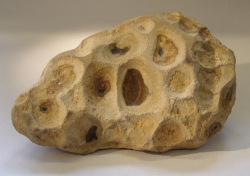 Flints with their surface covered with frost pits are evidence of periglacial conditions during the Devensian period.
The Doggerland plain stretched all the way from Norfolk to Holland and Germany. It had Arctic-type vegetation and was dotted with lakes and threaded by rivers draining the ice sheets to the north.. Wildlife included vast flocks of shore birds and water birds as well as Lemming, Wolf and Woolly Mammoth, adapted to the cold.
Distinctive flint handaxes found on local beaches are the work of Neanderthals, a cold-adapted human species living in Doggerland. All finds of flint tool finds need to be recorded by experts at the Norfolk Museums Service.
 A fine Neanderthal handaxe found on Walcott Beach. It is in good condition, suggesting that a prime archaeological site may lie just offshore. Image courtesy Jess Scott.
 Woolly Mammoth teeth may sometimes be found on local beaches – likely to be washed-up Doggerland debris. Their tooth-plates are more closely spaced than earlier mammoth species.
The three Anglian formations contain erratic rocks and fossils transported from wherever the ice sheets passed over. They are a fertile hunting ground for interesting specimens. NB the cliffs are likely to be hazardous, especially after rain or snow, so are best avoided – there is plenty to be found at beach level.